A well-known saying often repeated in higher education suggests that “universities are like graveyards; when you want to move them, you do not get much help from the people inside.” While the quote captures the frustration that sometimes accompanies institutional change, it oversimplifies the reality of faculty work.
Faculty are not inherently resistant to innovation. In fact, higher education is filled with educators who continuously adapt to new discoveries, evolving disciplines, changing student populations, and emerging technologies. Resistance is more often a response to overload than an objection to progress.
Today’s faculty face a growing number of competing demands. Curriculum revisions, assessment requirements, accreditation expectations, research and publishing obligations, committee service, student support responsibilities, and administrative initiatives all compete for limited time and attention. Added to these responsibilities is the rapidly evolving landscape of digital education, where new technologies, teaching practices, and instructional expectations seem to emerge almost daily.
Given these realities, those of us who support teaching and learning must be intentional in how we guide institutional change. Faculty need to feel connected to the process, supported throughout implementation, and equipped with the resources needed for success. Just as importantly, they must not feel overwhelmed.
This is where the concept of radical incrementalism becomes valuable.
What Is Radical Incrementalism?
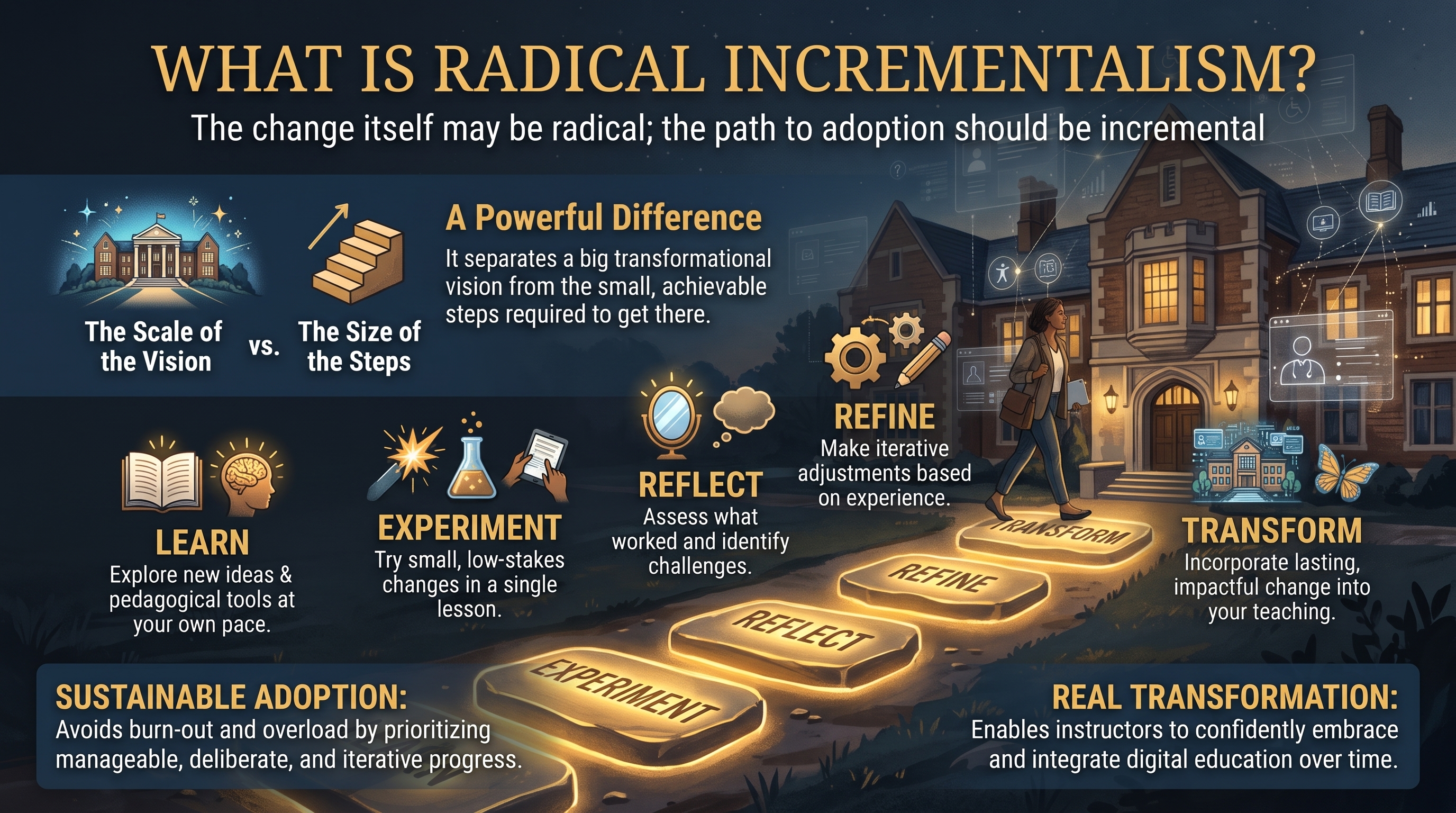
Radical incrementalism is not about lowering ambitions or slowing innovation. It is about separating the scale of the vision from the size of the steps required to achieve it.
The goals may be transformational. The destination may involve entirely new approaches to teaching, learning, assessment, or student engagement. However, sustainable adoption occurs when faculty can engage with those changes through manageable, deliberate, and iterative steps.
When instructors are given the opportunity to learn, experiment, reflect, and adjust over time, they are more likely to embrace change and integrate it meaningfully into their teaching practice. The change itself may be radical; the path to adoption should be incremental.
Digital Education Provides a Clear Example
Consider the emergence of generative artificial intelligence in higher education. In a relatively short period of time, faculty have been asked to reconsider assignment design, assessment practices, academic integrity policies, student skill development, and the role of technology in learning.
For many instructors, the challenge is not simply learning a new tool. It is understanding how that tool affects an entire course ecosystem.
A traditional change-management approach might ask faculty to overhaul multiple elements of a course simultaneously. A radically incremental approach would look different.
Faculty might begin by attending a short workshop focused on AI literacy. Next, they may experiment with a single classroom activity involving generative AI. From there, they could revise one assignment, share experiences with colleagues, and evaluate the impact on student learning before making additional changes.
The long-term transformation remains significant, but the individual steps remain manageable.
Meeting Faculty Where They Are
The same principle applies to nearly every major initiative in digital education.
When institutions adopt new learning management systems, faculty are often expected to migrate years of course content while maintaining their normal teaching and research responsibilities. When accessibility standards evolve, instructors are asked to review materials, redesign resources, and learn new compliance requirements. When online quality frameworks are introduced, faculty may encounter dozens of recommendations related to design, interaction, assessment, and learner support.
Each of these initiatives may be worthwhile. The challenge is that faculty experience them cumulatively rather than individually.
Institutional leaders often experience change as urgent, while faculty experience change as layered.
Radical incrementalism recognizes this distinction and responds accordingly. Rather than asking instructors to make sweeping changes all at once, it encourages progress through a sequence of achievable actions that build capacity and confidence over time.
The Importance of Feedback
Incremental approaches are most effective when faculty voices actively shape the process.
Too often, feedback is viewed as resistance. In reality, it is one of the most valuable sources of information available during implementation efforts.
Faculty feedback helps identify obstacles, clarify communication, reveal misconceptions, and uncover unintended consequences before they become significant barriers. It also allows leaders to adjust timelines, refine support resources, and better align initiatives with the realities of classroom practice.
Perhaps most importantly, feedback communicates that change is being pursued with faculty rather than to faculty.
When instructors believe their experiences and perspectives matter, they become partners in the process rather than recipients of it.
A Sustainable Path Forward
Higher education does not need less innovation. It needs innovation implemented in ways that acknowledge the realities of faculty work.
The future of digital education will continue to bring significant change. New technologies will emerge. Student expectations will evolve. Institutional priorities will shift. The question is not whether change will occur, but how effectively institutions help faculty navigate it.
Transformational goals do not require transformational-sized steps, they require consistent, meaningful, and sustainable progress.
If we truly want faculty to engage with the future of digital education, our focus should not be on accelerating change for its own sake. Instead, we should create pathways that allow instructors to move forward with confidence, clarity, and support.
In digital education, lasting transformation rarely happens through dramatic leaps. More often, it happens one intentional step at a time.


Leave a Reply