Search

eLearning Frenzy

eLearning is like a sewer, what you get out of it depends on what you put into it.

Category

elearning

BbWorld Blog: ConnectYard and University of Mississippi

BbWorld Blog: Engagement, Persistence and Retention:  How is the University of Southern Mississippi using ConnectYard to Successfully Enhance these Key Factors

Room 277
Tuesday 7/10/2012

Overall Concept: How Student Engagement and Persistence has a positive effect on retention.

Students and faculty choose course by course what channels they want to be communicated through.  (Facebook Twitter, Texting and e-mail)

Faculty doesn’t have to have a Facebook or twitter account to use ConnectYard for the students in their courses.

  • Social Media plays an important part in students’ lives.
  • U of M’s adoption of ConnectYard grew from a desire to improve communication and increase participation in online courses and enhance student learning.
  • Campus email is not an effective tool for student communication.

Hurdles:

– Marketing

– Faculty and Student buy-in

  • Fear that professors will have to access FB pages
  • Faculty concerned with added workload

Social Media Policy (prohibits faculty from using it to teach classes through facebook, but they can use it to supplement.)

Faculty/Student Buy-in

  • Easy to use
  • Building block Integration
  • Bridge to Social Media

Position ConnectYard

  • Integral part to each course
  • Stress privacy protection

Encourage students to personalize notifications

Stress Use to Quantify Class Participation.

Current use of ConnectYard

Getting Everyone Involved

  • Faculty to Student
  • Student to Faculty
  • Student to Student

Communication within Courses

Student Notification

How it works: Messages, Discussions and Announcements come through Channels (Twitter, Facebook, Text & e-mail).  Gradebook updates coming.

Planned uses:

  • Enhance Hybrid courses & supplementals
  • Communication/interaction tool between learning teams
  • Back Channeling during course and web presentations (students communicating with each other during lecture/video etc)
  • Intra-department interaction & communication
  • Campus Notifications
  • Student Services
  • Marketing & Recruitment

Personalize Channels

  • personal perferences
  • protect privacy

One way & Two Way Communication
Bb Integration

  • Discussion Boards
  • Announcments
  • Messages (Blogs, Wikis and Grades coming)

Participation Points
Granular Administration

Practice makes Best Practice

Cutting down on last-minute scrambling with technological glitches by having your students practice the activity before the real assignment or assessment is due.

One of the worst feelings as an instructor occurs when you work tirelessly to put together an assignment or assessment in your course only to have the technology fail you. You spend countless hours organizing an activity with the learning objectives in mind, ensuring the activity is perfectly aligned to the curriculum, only to find that the students can’t even access it because the technology isn’t working. Talk about frustrating!  While in some respects you will always be at the mercy of the technology gods, for example the old adage “It is not a matter of if technology will fail you, it is a matter of when.”, seems to come to mind.  However, there is a very proactive way to greatly reduce the chance of a technological failure in your course………Practice!

Oftentimes assignments, assessments and activities that deal with third-party software or technology other than the Internet browser take place at stressful times during the semester or are associated with a stressful activity (test taking).  At this point, you are taking the normal stress and anxiety levels associated with coursework and compounding them with the added fun of using a new or different technology.  Why not introduce your students to the “new tech” at the beginning of the semester or make the activity less than 25% of the course grade.  Below you will see some great examples of “practice activities” that you can use in your course.  You don’t have to limit yourself to these activities as this best practice transcends just these examples.

The Syllabus Quiz (Killing 3 birds with one stone)

This activity touches in three important areas that will affect how the student goes through the rest of your course. By completing this exercise the student will:

  • become familiar with the testing mechanism in the learning management system before they take their first major exam or quiz.
  • learn how to use-third party applications (lockdown browser or remote proctoring) to ensure academic honesty during the assessment without the added anxiety of a big test being due.
  • at least know the information in your syllabus that you think is most important, ensuring that they have at least looked at the syllabus once during the course.

NOTE: Be sure to make the Syllabus Quiz worth enough points so that the students will follow through on taking it.

The “Introduce Yourself” Presentation

One of the ways we can bridge the gap of interactivity in online and Hybrid courses is to allow students to record presentations and upload them to the course.   This means that the student can present a project, assignment or some other activity while sharing video, audio and whatever is running on their desktop or laptop computer.  We all know that many students undergo stress when they have to give an oral presentation.  Take that stress and tie it to the added stress of “Can they hear me?”, “Is my webcam working?”, and “Can they see my PowerPoint?”.  Give your students a fun activity at the outset without the added pressure of a major assignment deadline and the stress diminishes considerably.

Sample “Introduce Yourself” Presentation Guidelines

  • Place activity in first week or getting started unit of your course.
  • Include directions on how to access recording tool and start recording.
  • Have student create a 3-5 slide PowerPoint or Keynote presentation that Introduces them to the class and record themselves giving the presentation.
  • Tell them to have fun with the presentation!

Note:  Tools that can work for this assignment include:  Adobe Presenter, Slide Bloom, Tegrity, Jing etc.. It will depend on if you want a view of the student along with the presentation.

Use this Concept in other Scenarios

This principle applies to many other activities you may do in your course.  Having your students use a wiki to post their educational and professional goals and it will be easier for them when it comes to completing group projects, case studies and portfolios using wikis later.  If you require your students to meet with you in real-time using a webinar tool, it is always a good idea to have a pre-meeting meeting to iron out any difficulty they might have in getting the web conferencing tool to work. A web meeting room is another tool where a Microphone headset is mandatory.  You never want to get stuck in that feedback loop that comes from hearing yourself in someone else’s speakers during a web conference.

In conclusion, you can avoid the wailing and gnashing of teeth that takes place when students encounter a technical difficulty by practicing and ironing out the bugs. This best practice can save your life when it comes down to evaluation time.

Note: In most cases work with whatever support system you have to let them know when your students will be doing the dry run so they know to expect the phone calls and e-mails.

Feedback Strategies for your Online Course

Feedback Strategies in your Online Course

I originally posted this over at the SHSU Online blog in March.

Engagement in online courses is key for student success, teacher evaluation and the overall course experience.  A great way to promote student engagement in your online course is to work on feedback. Students that receive regular feedback tend to perform better and as a result have good opinions of their time in the course.  There are many sound strategies for providing feedback in an online course.  For our purposes, we will focus on four of them: Audio Feedback on assignments, Summing up Student Discussions, Peer Feedback and Feedback from the Future.

Audio FeedbackAudio feedback on assignments:
Adding your voice to feedback on assignments can be very beneficial for you and your students.  Giving voice to your thoughts cuts down on misconstruing the intent of the message and allows for emphasis to be easily related.  The students also feel more connected with you and will be more likely to become engaged in the course.  Having different types of feedback helps with content retention so more of what point you were trying to get across is retained.  Finally your students will feel like you take a more personal interest in their learning in that you are leaving audio feedback that is specifically for them.

Summing up discussion – providing kudos and challenges
Discussion SUmWe all know that asynchronous discussions are powerful tools in any online course.  What is also known is that they can be a lot of work for any online instructor.  Trying to post replies for all students in a larger class, across multiple boards throughout a semester can be a daunting task under the best of circumstances.

A great way to provide feedback for classes with a large amount of discussion board traffic is to provide a weekly summation post/e-mail/announcement.  This summation not only allows you to wrap up the topic and direct further research and review, it also allows you to give out kudos for well thought out posts (by name) and challenge postings that may have fallen short for one reason or another.  The kudos and challenges promote engagement by letting the students know you are reading and letting you know that they are thinking critically about the topic.

Peer FeedbackPeer Feedback
Peer feedback in online courses serves the wonderful purpose of reinforcing concepts the student is learning, but it also promotes accountability and engagement in the course.  In order to comment intelligently on each other’s work the students must have at least a basic understanding of the concepts they are discussing.  Not only do they have to think critically about the content they are posting, but they also must put thought into how to respond to the ideas of others.

Making peer feedback part of your course structure promotes accountability.  For example if group members know that part of their grade will take into account member feedback about their performance in the group they will be more apt recognize that they will be held accountable in terms of group work.

Feedback from the FutureFeedback from the future!
Another title that might more aptly describe this concept is “preventative feedback”.    This could be something as simple as popping an e-mail to a student who hasn’t checked into the course in the past couple of days, or looking at how the student is trending in your course gradebook to come up with a roadmap for their success.

Be giving preventative feedback, you might reconnect with a student lost in the jumble of ones and  zeros or help the student who is struggling with a particular part of your course, thereby avoiding the ultimate in bad feedback: the failing grade.

Expectations

Note:  I actually posted this article on the SHSU Online Blog, but thought it worth while to share here as well.

One of the biggest stumbling blocks in online courses for students is having their expectations of the course meet reality.  There are two easy steps you can take to ensure your students know what to expect in your online course.

  • Place learning objectives throughout the course
  • Create an Expectations content item

Place Learning Objectives Throughout the Course

Due to accreditation requirements, your objectives will show up in your course’s syllabus so the students will be able to find them there.  However, you can really reinforce what the students will be getting out of course units and items by placing Unit and even Content Item level objectives.  Starting out each unit by letting students know what they can expect from it will remind them why they are involved in those activities and reinforce with you the desire to align your curriculum.  Putting an assignment level objective will go further to reinforce what they are learning and why.

Create an Expectations content Item

A great way to cut down on student confusion about course expectations and activities is to create an Expectations content item in your course.  This part of your course should contain 2 sets of expectations:  What you expect of your students and what your students should expect from you.  You can even have your students post that they have read and understood the course expectations as a gateway for your course content.

Examples of Course expectations:

Expectations of Students

  • Use the virtual office to ask general course questions
  • Check the course homepage, discussions and their e-mail several times a week
  • keep up with reading assignments, activities, assignments and quizzes
  • Participate actively in class discussions, responding to at least 2 colleagues for each forum
  • Practice Netiquette in the course.  No flaming (negative hurtful comments); use correct grammar and spelling; don’t yell (write in all caps)

Expectations of Instructor *These will vary depending upon your comfort level

  • I will read and respond to discussion posts directed at me, e-mails and other forms of communication daily (not on weekends)
  • I will post grades for your assignments and exams quizzes within a week of submission
  • I will have office hours at these days/times: (insert times here) via Skype (Skype address here) or via phone (phone number here)

Letting your students know what to expect from you and what you expect from them will go along way toward ensuring a successful experience for them and you in your online course(s).

Why I want to be a VIP BbWorld Blogger

CommunitySo if you’re reading this, you may be asking yourself “Why does this guy want to be a VIP BbWorld Blogger?”  This could be because you honestly want to know, or you just may be reading the title of my Blog post out loud. Regardless of why you are asking yourself that question (or just reading), I’ll tell you in one word… Community.

My name is Jacob Spradlin, I am the Assistant Director of Training and Development for the department that handles Distance Education at Sam Houston State University in Huntsville Texas.  I hold a Master’s in Instructional Technology and have over 15 years experience in the field.  I have worked with Blackboard in one form or another since 2000.   My current job involves online course development as well as training for faculty here at SHSU.

For a long time, (I believe that 1 eLearning year is like 7 regular years) I have been interested in building community on my campus when it comes to eLearning.  I started our first local Blackboard users group back in the early double oughts and learned first-hand how powerful it was to put people together so they can learn from each other.  Getting 2 English faculty in same room or even cross-pollinating the disciplines lead to wonderful discussions and discoveries.

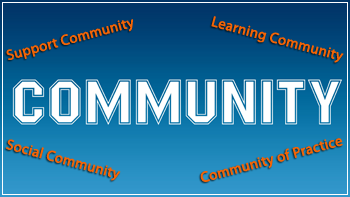
After a while longer in the game I’ve come to the determination that their are four major communities at work in eLearning:

  • Learning Communities
  • Support Communities
  • Social Communities
  • Communities of Practice

Your Learning Community is the obvious choice in that you try to make your course(s) a community of learning.  You might think of it as the “Guide on the Side on Steroids”, where your students with equal parts professor interaction, feedback and prompting; interact with each other, reflect and build upon the knowledge and skills that they are learning.

The Support Community is now almost the gold standard for eLearning, where you use the Tool to support the tool.  Whether it is a Faculty Resource course or a Student Orientation course, you leverage the technology so that they practice using it to find the answers they need.  Our most recent accomplishment at my institution is the beginnings of an Online Certification process where the faculty use the online tools to learn and become certified to teach online.

Social (insert concept here) seems to be the buzzword these days.  It is easy to say I don’t want my course to be like Facebook or Twitter, but is is harder to ask yourself “how are my students communicating?” or “where are they living digitally?”. A Social Community gives your students a sense of home away from home and for online students it creates a connection with the university that helps fight off the “I’m just a lonely student taking courses on the Internet” syndrome.

Communities of Practice have found a home in the eLearning spectrum.  Departments, divisions and other constituencies share professional learning, documentation and knowledge base resources by using this vehicle.  Content Repositories are tremendous assets for these communities.

So, “Is he going to get around to why he wants to be a VIP BbWorld blogger?”  Don’t worry I am, I just wanted to provide some context.

What better community to interact and learn from than the BbWorld community? What better event to foster innovation, creative design and fundamentally shifting the way we communicate than BbWorld 2012? Hundreds of sessions will taking place that will expand our community of support. Thousands of people will attend who will grow our social community.  Ideas, resources and conversations will take place that will add to our community of practice.  This event encompasses exponentially one of the largest learning communities in the world. So instead of asking why I would want to be there, it might be better to ask why I wouldn’t want to be there?!

Not only will i be recording for posterity my observations of a awesome event, I will also be communicating to my eLearning communities and reflecting my experience so that others can take part.

So here i am begging the eLearning gods to, tearing my educational sack cloth, wailing and gnashing my teeth…Please let me be a VIP BbWorld Blogger this year so that I can communicate about the community that I love so much!

Sincerely,

Jacob Spradlin

Create a free website or blog at WordPress.com.

Up ↑