- Overview of attendance functionality
- Feature/service architecture
- Integration architecture
- Impact and future guidelines

- Foundation for future integrations into product portfolio
- Separate application and data store, singer source of truth
- API First
- Take advantage of latest tech
Service Architecture
- Multi-tenant service, data serrated by unique user I’d
- Application tier developed in java
- Dropwizard library for API/controllers
- JDBI for data access
- Flyway for database scheme management
- Deployed as docker containers on Kubernets
- Postgres 9.6 for database
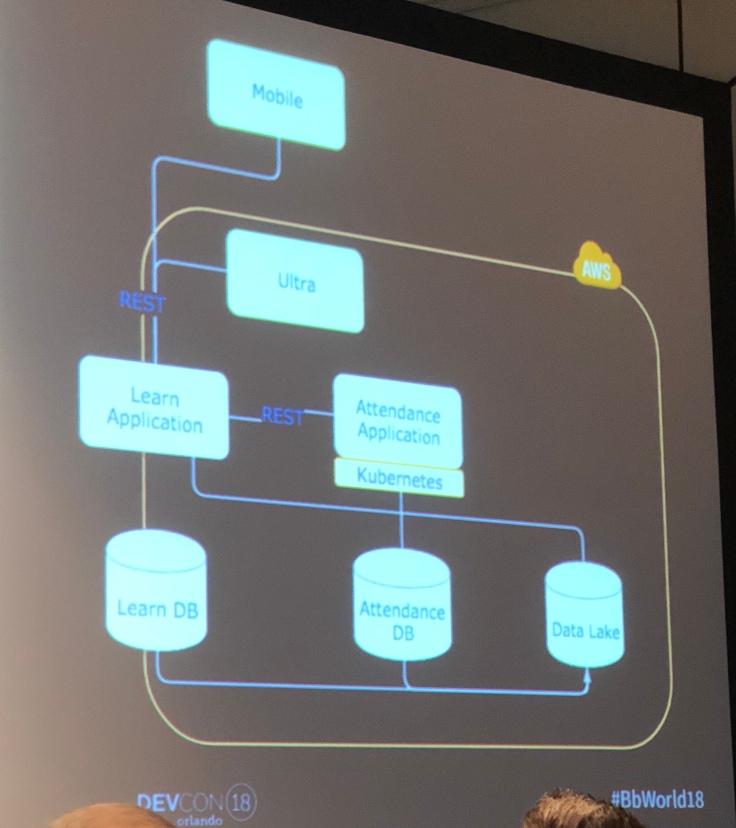

Building Functionality as a separate service has advantages.
- Separate application & database adds no load to learn
- Natively built on REST API, easy to integrate into other products
- Standalone, small service can choose the most appropriate technologies for a given function
- Separate service can be tested and deployed in isolation.
Integration Architecture
- Standalone SaaS easily integrated across portfolio
- integrate 3rd party services through developer portal (future)
- API first (REST) enables complete access to service functionality through APIs

- Building services as separate has advantages can can be applied to broad set of problems
- Important architectural pattern that will help apply on larger scale over time
- Leads to tighter integration and more consistent functionality across product suite
- Services can be gradually rolled out and integrated Bb applications
- Scalability of entire eco-system will improve over monolithic application: more stable, more consistent and predictable performance
- Used in other areas besides attendance, box integration, cloud storage integration, Ultra institution pages.
General Impact
- Service based architecture is mostly transparent to end users, but affects developers and integrators.
- Not all data I contained in LEARN anymore
- Not all functionality is available via Java API anymore
- Data will be aggregated into data lake
- Functionality is exposed through REST APIs
- Use REST APIs to future prof customizations and extensions.





 The Wiki Tool
 The Blog Tool
 If you teach online in higher ed, then you are familiar with the effort, energy and involvement it takes to engage with your students in that environment. If you’ve taught online for more than a few semesters, then you know that you do need to put some thought into your transition of teaching a class from semester to semester. Thought goes into your course materials, learning objectives and how your class is setup in Blackboard or whatever flavor of LMS you use.
 July 14, 2016